



The Challenge: High-Demand TVAC Environments Require High-Integrity Feedthroughs
Space simulation facilities have demanding vacuum system requirements that leave little room for error. Thermal vacuum chamber (TVAC) testing demands power, signal, and data transmission in and out of the system without compromising the space-like conditions within the chamber. These conditions require hermetic conditions for all electrical, data, and power pathways that enter and exit the chamber.
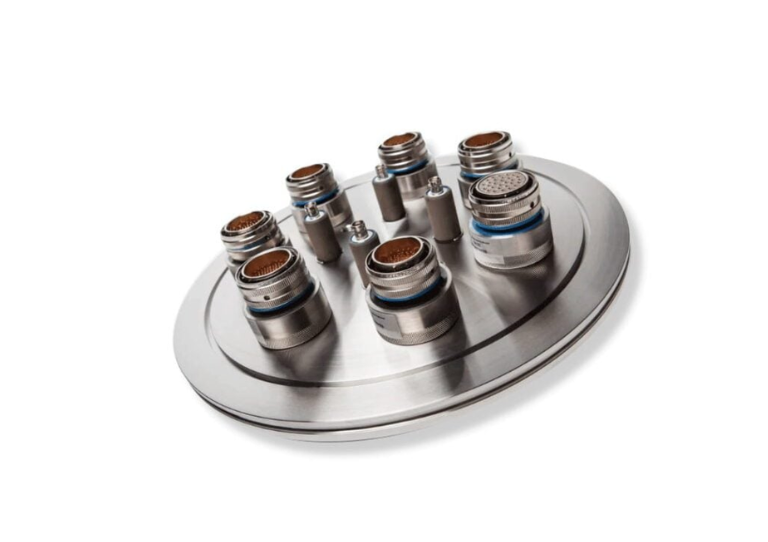
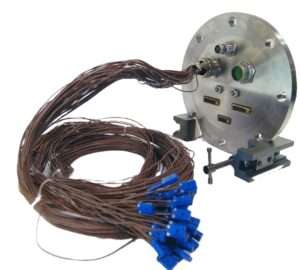
One of the most effective ways to support testing is by outfitting the TVAC with a Douglas PortPlateTM – a modular, multi-feedthrough penetration (pen) plate designed to fit standard chamber openings engineers use to easily customize their setup. They can mix and match different types of pass throughs while still maintaining reliable, high-quality power, signal, and data transmission.
As testing environments grow more complex, engineers increasingly rely on specialty electrical components. When these specialty parts need to pass through the chamber wall, they too must meet the same strict hermeticity requirements. Fortunately, it’s possible to take commercial off-the-shelf specialty parts and create a hermetic seal that fits within a PortPlate TM, all using one vendor. This enables engineers to choose the optimal parts for their testing setup while still addressing hermeticity.
Specialty components can also be hermetically sealed and integrated into larger PortPlateTM solutions in one place, transforming TVAC performance and unlocking new flexibility for space‑simulation engineers.
What This Means for TVAC Engineers
- Port plates simplify TVAC feedthrough management by allowing multiple power, signal, and data connections in one modular plate.
- Specialty electrical parts are often not hermetic, making them incompatible with vacuum chambers without additional modifications.
- Hermetically sealing commercial off-the-shelf components enables engineers to use high-performance specialty parts without compromising vacuum integrity.
- Hermetic conversion reduces cost, lead time, and complexity compared to sourcing or designing custom hermetic components.
- Using one vendor to build a port plate and hermetically sealed specialty parts creates a flexible, reliable, and future‑proof solution for space simulation environments.
Why PortPlates TM Are a Game Changer for TVAC Feedthroughs
PortPlates TM transform a single chamber opening into a versatile, multifunction port for pass throughs. Douglas Electrical pioneered these hermetic, custom multiport feedthrough systems, which are designed to fit standard chamber openings and minimize leak paths by consolidating many pathways into one vacuum tight plate. They can be provided fully assembled and pre-tested, reducing the time needed to get the system up and running.
Key benefits include:
- Modularity: Mix and match electrical, optical, and signal feedthroughs as needed.
- Space efficiency: Replace multiple single feedthrough components with one consolidated plate.
- Ease of installation: Drop‑in compatibility with standard TVAC port sizes.
- Future‑proofing: Easily reconfigure or swap feedthroughs for new test campaigns.
By streamlining feedthrough management, port plates dramatically simplify TVAC setup and reduce both installation time and maintenance overhead.
The Missing Link: Hermetically Sealing Specialty Electrical Parts
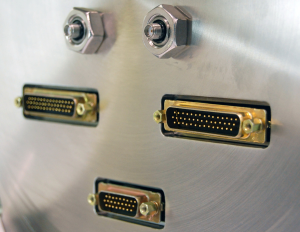
Despite their flexibility, port plates are only as effective as the components installed in them. Many specialty components are not hermetically sealed by default.
This creates a critical challenge: how can engineers use the exact components required for their test while still preventing vacuum leaks?
The solution: Hermetic conversion of commercial off-the-shelf (COTS) specialty parts
Partnering with a vendor that can hermetically seal specialty components offers both optimal performance and vacuum integrity:
- Engineers use the optimal part for performance and data integrity.
- The part is adapted to maintain a vacuum tight seal.
- No need to redesign the component or compromise on test capabilities.
What does hermetic sealing accomplish?
Hermetically sealed specialty parts:
- Prevent gas permeation into or out of the chamber
- Improve component performance and reliability
- Ensure consistent vacuum levels during long-duration tests
- Protect sensitive electronics from atmospheric moisture and contaminants
- Reduce the risk of leaks associated with ad hoc sealing attempts
This approach allows engineers to confidently incorporate high-performance specialty electronics into PortPlates TM without sacrificing chamber integrity.
How Hermetic Conversion Can Work
Although each part is different, the conversion process typically includes:
- Evaluating the off-the-shelf component
Engineers review the part’s geometry, materials, and connection requirements. - Designing a compatible hermetic housing or sealing interface
Douglas Electrical Components’ low-gassing epoxy has the versatility to hermetically seal to specialty parts made from a variety of mechanical interfaces and materials. - Integrating the specialty part into a vacuum‑rated housing
The assembly is designed to fit directly into a PortPlate TM opening. - Testing for vacuum performance
Components are leak‑checked and verified to meet electrical and vacuum requirements.
This process converts everyday components into mission‑ready, vacuum‑compatible solutions.
Benefits of Using Hermetically Sealed Specialty Parts in PortPlatesTM
- Greater Test Flexibility
Engineers can choose the exact connector, sensor, or electronic device required for mission‑critical accuracy. - Reduced Lead Times
Instead of waiting for custom hermetic components, COTS parts can be adapted quickly and installed into a larger PortPlate TM. - Lower Cost
Hermetic conversion can be far more cost‑effective than designing custom vacuum‑rated components from scratch. - Improved Reliability
Hermetically sealed components maintain performance across:
- Extreme temperatures
- Vacuum conditions
- Long-duration test campaigns
- Seamless Integration into Existing TVAC Systems
Converted components drop directly into PortPlate TM openings—no redesign required.
When PortPlates TM and Hermetically Sealed Specialty Parts Come Together
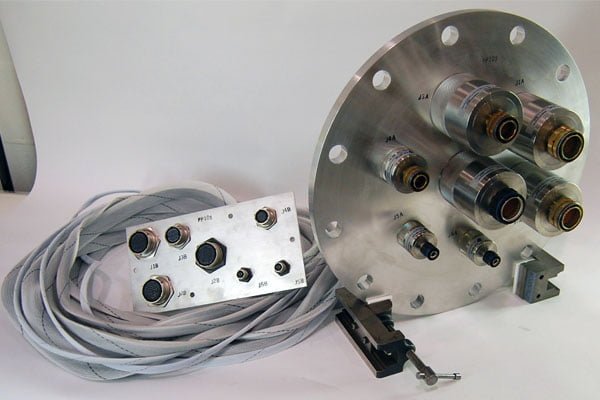
Portplate hermetic feedthrough flange with PotCon electrical feedthroughs
Douglas Electrical Components goes beyond providing PortPlate TM assemblies—they also hermetically seal the specialty parts that need to be integrated into them. Because Douglas can perform both tasks in‑house, engineers streamline sourcing, design, and installation while reducing risk and turnaround time.
This dual capability means one vendor can:
- Build the custom PortPlate TM
- Hermetically seal commercial off‑the‑shelf specialty components
- Integrate everything into a single, leak‑tight assembly
- Deliver a plug‑and‑play solution optimized for your test conditions
Engineers save time, reduce complexity, and eliminate the risks associated with coordinating multiple vendors or performing ad‑hoc sealing attempts.
A Single-Vendor Path to TVAC Testing Readiness
By combining PortPlate TM fabrication with hermetic sealing expertise, Douglas Electrical Components offers a uniquely streamlined path for building out TVAC test setups. Whether you’re routing power-dense electronics, specialty sensors, fiber optics, or high‑frequency connectors, Douglas ensures each component is vacuum-ready, pre‑tested, and integrated into a single plate that fits your chamber’s existing mechanical interface.
In space simulation environments where reliability, schedule, and configuration flexibility are critical, this integrated approach simplifies the feedthrough management process and delivers reliable, vacuum tight performance.