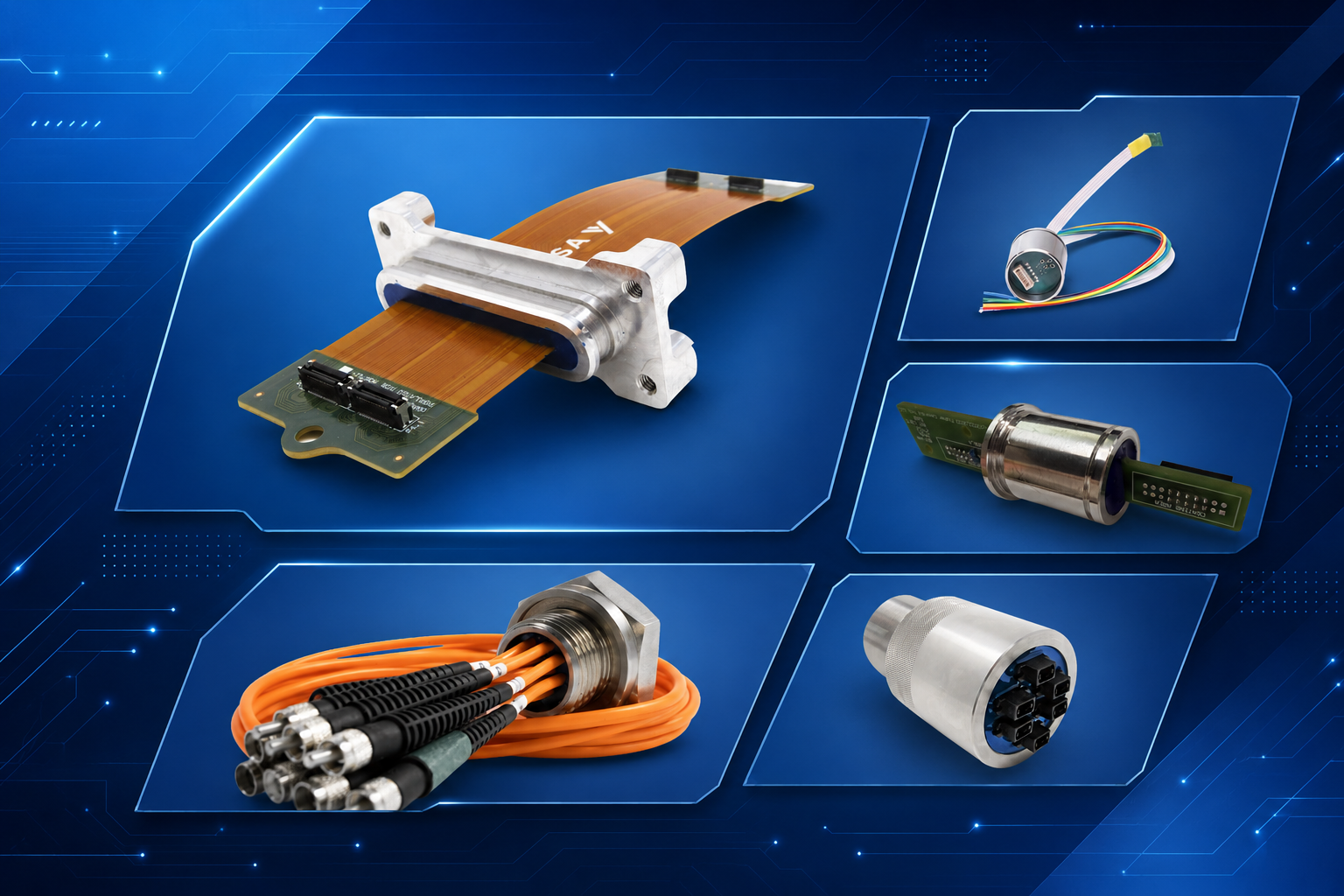
Lighter. Faster. Reliable. Built for What’s Next.
Rapidly evolving aerospace and defense (A&D) systems are driving demand for more efficient, higher-density signal connectivity to support next-generation technologies. The industry is continually seeking lightweight options for high-density signal transmission in harsh environments. These capabilities are essential to support highly critical missions. These missions require signal connections that are reliable, efficient, and robust.
Leading A&D companies are turning to hermetic fiber optic feedthroughs and circuit seals technologies. These advanced interconnect solutions are essential to meet today’s ever-growing demands. They deliver the high-density, compact, and lightweight solutions modern systems require.
Key Takeaway: Hermetic fiber optic and circuit seals provide flexible, fast, high-density feedthroughs, aligning with the aerospace & defense industry’s need for compact, lightweight, and reliable signal transmission.
Aerospace & Defense: Signal Reliance
The military relies on a wide range of technologies that are essential to its operations, and these systems require strong, reliable signals to function at peak efficiency. Even when the hardware itself is fully operational, degraded or jammed signals can render the technology ineffective.
The A&D sector faces unique challenges that demand stronger and more resilient signals to withstand:
- Harsh environmental exposure
- Shock, vibration, and mechanical stress
- Hostile interference or attacks
- Electronic interference and contested environments
- Increasing data, bandwidth, and processing demands.
As technology advances and the A&D industry continues to modernize, the need for reliable signals only grows. Capabilities such as AI-driven data centers and autonomous systems were virtually nonexistent twenty years ago but are now integral to modern A&D operations. What was most efficient yesterday for optimal signal density may not be tomorrow.
Moving to the Future: Interconnect Innovation in A&D
In the early 1930s, the circular connector was introduced, and by the onset of World War II, it had become the primary tool for signal connections in the aerospace and defense industry.1
By the 1960s, as electronic systems evolved, application requirements began to diverge, leading to the adoption and use of the compact D-subminiature connector.2
In 1992, the Department of Defense established the ‘High Performance Computing Modernization Program’ to accelerate advanced computing capabilities across defense systems.3
By the 2010s, emerging technologies such as quantum computing started receiving significant large-scale investment from the National Security Agency.4
Today, A&D systems impose uniquely stringent requirements, demanding interconnect solutions that are both highly compact and exceptionally reliable in extreme environments. The need for fiber optic and circuit seals has never been greater.
All of these connector and feedthrough solutions are still in use, but in some applications bulky circular connectors can be limited by size, while D-sub connectors may not provide the necessary level of environmental ruggedness. That’s where next-generation interconnect solutions come in.
Fiber Optics: The Need for OptiSeal™
High-speed, high-density optical connectivity built to survive extreme environments.
The rise in fiber optic use
Fiber optics usage is on the rise because it carries large volumes of data at ultra-fast speeds. In the military, fiber optics is replacing copper to support cutting-edge equipment for navigation, combat, safety, monitoring, and other critical operations. Other benefits of fiber optics:
- Impervious and immune to EMI (electromagnetic interference)
- Very low signal loss over long distances
- Exceptional signal security
- Ability to add future bandwidth without additional hardware.
Hermetic seals protect fiber optic infrastructure from damage and potential failures, enabling reliable data transfer for decades.
What is a fiber optic seal?
A fiber optic seal is a connector in which an optical fiber is hermetically bonded, ensuring that:
- Air, moisture, fuel, and contaminants cannot penetrate.
- Pressure differentials (up to 15,000 psi) remain contained.
- Vibration does not loosen the interface.
- Temperature cycling does not disrupt alignment (4 K to 200 °C).
- The optical signal passes through unaffected.
Fiber optic seals provide an effective method for transmitting high-speed, noise-free signals over long distances while maintaining environmental integrity.
The introduction of OptiSeal solutions
At Douglas, we have been producing hermetic fiber optic solutions since the 1990s through our OptiSeal series. Our engineers researched and developed this capability to match growing interest in fiber optic usage, which has evolved further as our clients look for different ways to incorporate fiber optics into their solutions. The OptiSeal series provides several benefits, including:
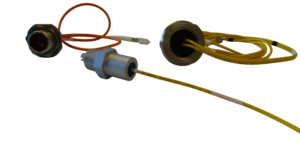
- The ability to hermetically bond directly to the optical fiber to create a true seal either within the assembly bulkhead or without the bulkhead.
- A reliable seal in the face of vibration and large temperature swings.
- Capability to seal from 1 to over 100 fibers.
- Options for a hybrid feedthrough harness combining copper conductors, fiber optic cables, thermocouples, power cables, shielded pairs, triplets, quads, and more.
- Multiple configurations, allowing clients to find the best solution to meet their business and application requirements.
Fiber optic seals are well-equipped to meet the rigorous and specialized demands of aerospace and defense systems, and OptiSeal solutions further extend those performance capabilities. One of our clients, a Tier 1 A&D manufacturer, used a hermetic OptiSeal feedthru to meet environmental requirements and cut the mechanical interface weight in half.
Hermetically Sealing Rigid and Flexible PCBs: The Advantages of CircuitSeal™
Compact, lightweight, hermetic sealing for advanced electronics.
The growing demand for PCB seals
The demand for circuit seals continues to grow alongside the expansion of computerization, miniaturization, and data centers, which require lightweight and reliable sealing solutions for circuit boards. This need is even more pronounced in A&D applications, where advanced systems rely heavily on computing infrastructure and demand durable, high-performance electronic sealing technologies. Benefits of circuit seals include:
- Improved performance: maintain signal integrity while eliminating losses or electrical noise (EMI) associated with electrical connection points.
- Lightweight, compact size: typically 30%-70% smaller than comparable connector or wire-based solutions.
- Enhanced protection from outgassing: passive components are potted and hermetically sealed.
- Minimized connection points: integrating signal conditioning and sensing directly into the hermetic feedthrough reduces required cable harnesses, further decreasing system complexity, cost, and size for our clients.
- Improved reliability: sealing performance is fully hermetic, with leak rates below 1 x 10⁻⁸ cc-He/sec at pressures exceeding 2,000 psi.
What is a CircuitSeal?
Circuit seals refer to the process of hermetically sealing and encapsulating connectors and electronic circuits within a low-outgassing, chemically inert hermetic epoxy. They provide multiple benefits, including:
- Protect against water vapor, condensation, and contaminants.
- Resist vibration loosening and corrosion.
- Reliable, interference-free signal transmission.
- Suitable for space- and weight-constrained applications.
Circuit Seals can integrate a variety of circuit board and electrical connection types including flex, rigid, hybrid and flat flex cable (FFC).
The rise of CircuitSeal
At Douglas, CircuitSeal solutions began gaining traction in the early 2000s alongside the rapid growth of computerization, data centers, and increasingly complex circuit board designs. As electronic systems became smaller and more advanced, the need for lightweight, reliable sealing solutions grew significantly.
What sets CircuitSeal apart from conventional circuit sealing solutions is the design flexibility it offers. Engineers can integrate hermetic sealing directly into compact electronic packages, allowing for smaller, lighter, and more efficient system designs. Additional benefits of CircuitSeal include:
- Hermetic sealing for standard non-hermetic connectors, enabling direct integration into printed circuit boards (PCBs) or flexible circuits.
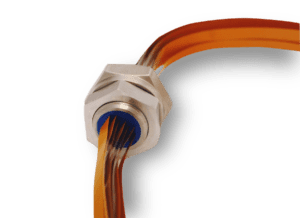
Multi-flex hermetic feedthrough circuit with face seal housing and jam nut
- Epoxy materials and mechanical assemblies engineered to perform reliably in both vacuum and positive pressure environments across a wide temperature range.
For aerospace and defense, typical applications for CircuitSeal include military weapon and transport systems as well as sealed off laser systems.
CircuitSeal solutions enhance durability, preserve signal performance, and enable reliable operation in extreme conditions, delivering superior performance compared to conventional alternatives in aerospace and defense applications.
Conclusion – Meeting Signal Density Demands
As aerospace and defense platforms continue to evolve toward higher data rates, greater autonomy, and tighter packaging constraints, traditional connection methods are reaching their practical limits. Signal integrity is no longer determined only by the electronics themselves, but by how effectively those signals are protected, transmitted, and integrated within demanding operating environments.
OptiSeal and CircuitSeal solutions both address these interconnect challenges by:
- Increasing signal density without increasing the system footprint.
- Providing hermetic protection against moisture, pressure, vibrations, and contamination.
- Supplying superior EMI resistance and signal integrity in contested environments.
- Producing weight and size reduction critical for aerospace platforms.
- Delivering long-term reliability under extreme thermal and mechanical stress.
- Supporting higher-frequency and high-bandwidth communication systems.
- Offering valuable design flexibility and efficiency.
The next generation of mission-critical systems will depend not just on advanced electronics, but also on equally advanced hermetic feedthrough and connector solutions. By replacing legacy connector approaches with hermetic fiber optic and circuit sealing solutions, aerospace and defense platforms gain the reliability, performance, and scalability required for future operations.
Reach out today and let our engineers help you build a more reliable system!
With over 80 years’ experience in the field, we understand how to evaluate complex systems and identify the right-fit solution for each unique environment. From initial design through the entire product lifecycle, we provide ongoing support long after purchase.
References
- MEPCA (2019, April 4). 50 Years in Circular Connectors. MEPCA Magazine
- Geek, C. (2023, May 12). Don’t Dismiss Old Ideas. RS. Retrieved from https://www.rs-online.com/designspark/dont-dismiss-old-ideas.
- Program History. (2026). DoW High Performance Computing Modernization Program. Retrieved from https://hpc.mil/who-we-are/program-history.
- Mabunay, T. (2024, January 3). US Government Quantum Timeline. QuSecure. Retrieved from https://www.qusecure.com/us-government-quantum-timeline/.